


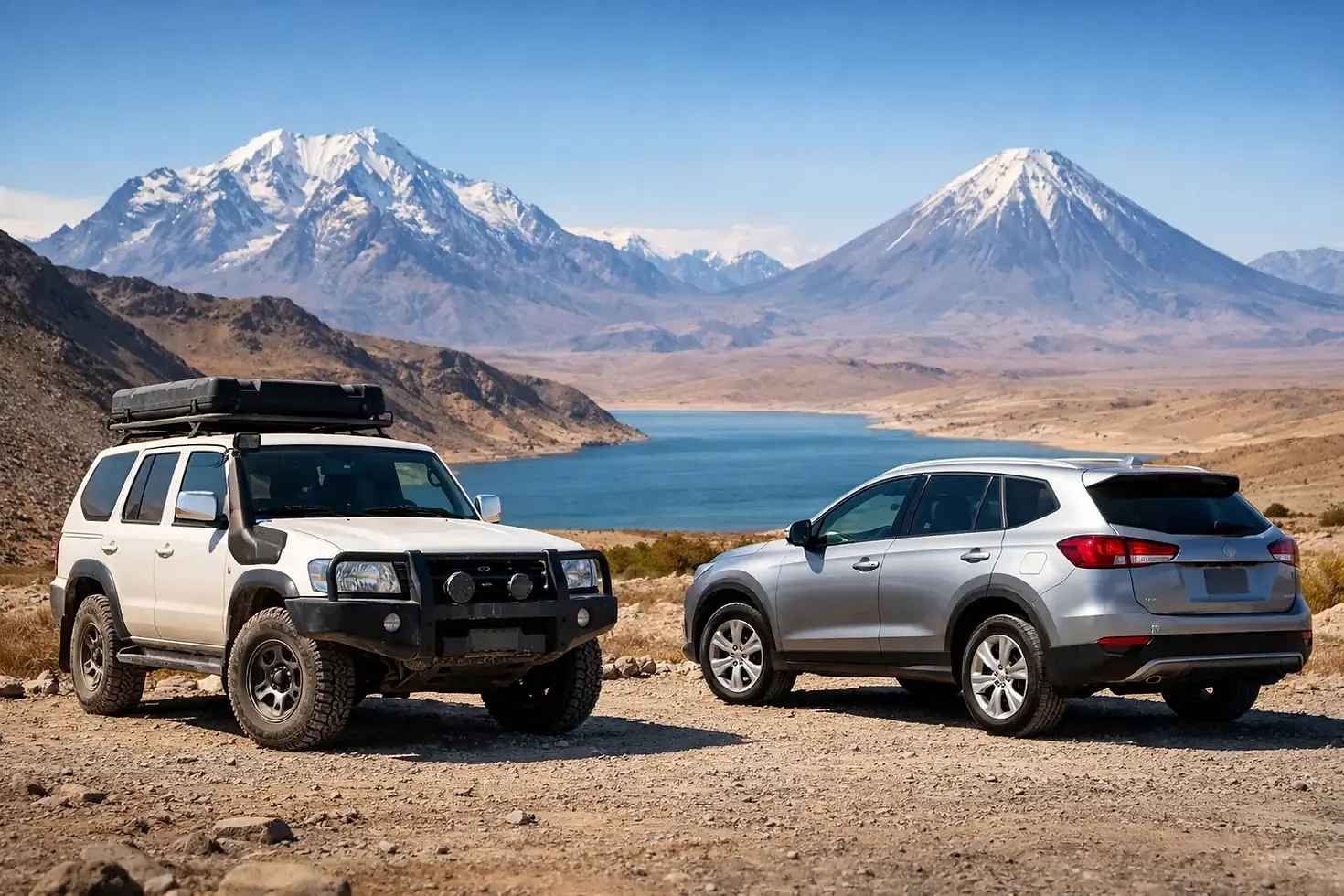
4WD Rental vs SUV Rental: Which Fits Chile?
- Aug 28
- 6 min read
A rental car can determine whether your plan stays on schedule or becomes a long detour. In the 4WD rental vs SUV rental decision, the right answer depends less on how adventurous your trip sounds and more on the roads you will actually drive, the equipment you carry, and the weather you may face.
For a city-to-city route through central Chile, an SUV is usually the practical choice. For remote Patagonia tracks, high-elevation routes, deep sand, or a self-supported itinerary with a camper, a true 4WD can be the vehicle that keeps your trip moving. The difference matters because Chile and Argentina can change quickly once you leave the main highways.
4WD Rental vs SUV Rental: The Real Difference
An SUV describes a vehicle shape and size. It may be front-wheel drive, all-wheel drive, or four-wheel drive. A 4WD vehicle has a drivetrain designed to send power to all four wheels, typically with selectable high and low ranges for difficult terrain. That low-range gearing is the key distinction. It helps at low speeds when climbing loose, steep, rocky, muddy, or sandy sections.
Many rental SUVs are all-wheel drive, not true 4WD. AWD improves grip on wet pavement, gravel, and light snow, but it is not intended for repeated off-road recovery work or technical tracks. An AWD SUV can be excellent for traveling between Santiago, the Lake District, Torres del Paine access roads, and Argentina's major routes. It is not automatically suitable for every road marked as remote on a map.
The label on the booking page is not enough. Before confirming a vehicle, ask about drivetrain, ground clearance, tire type, spare tires, permitted roads, and recovery equipment. A high-clearance vehicle with the right tires may matter more than a luxury interior once you are several hours from the nearest town.
When an SUV Rental Is the Better Choice
An SUV rental works well for travelers who want comfort, space, and a straightforward driving experience without paying for off-road capability they will not use. It is often the sensible option for a one- or two-week itinerary based around established destinations and paved or well-maintained gravel roads.
Choose an SUV if your route includes Santiago, Valparaíso, wine country, the Atacama's primary tourist roads, Puerto Varas, Bariloche, El Calafate, or the main approach routes to national parks. These areas can involve gravel, wind, rain, and rough shoulders, but they do not necessarily require low-range 4WD.
SUVs also make sense when fuel cost is a priority. A smaller AWD SUV generally uses less fuel than a heavier 4WD camper or pickup-based vehicle. It is easier to park in cities, simpler to load at supermarkets, and often more comfortable for long days on pavement. For two travelers carrying standard luggage and hiking gear, that balance can be hard to beat.
There is one condition: do not book an SUV assuming you can take it anywhere. Rental agreements may prohibit unpaved roads, river crossings, beaches, or remote tracks, even if the vehicle has AWD. Insurance coverage can also be limited when a vehicle is driven outside approved areas. Confirm the rules before you build your route around a remote destination.
SUV rental is usually right for these trips
An SUV is a strong fit for travelers who want to cover distance efficiently, stay in hotels or established campgrounds, and use main road networks. It is also the better choice when your itinerary has tight dates, because mechanical complexity and challenging terrain add time to every driving day.
If you are unsure, plan for the conditions you will face 80 percent of the time, not the single rough road you saw in a video. You can often join a guided excursion for that one difficult section instead of renting a specialized vehicle for your entire trip.
When a 4WD Rental Is Worth It
A 4WD rental is not just for extreme off-roading. It is for travelers whose route depends on access, self-sufficiency, and a margin of safety when conditions deteriorate. This matters most in Patagonia, the high Andes, and remote sections of northern Chile and Argentina, where wind, washboard roads, mud, snow, and long distances between services are normal parts of the trip.
Choose a true 4WD when you expect sustained rough gravel, steep loose climbs, soft sand, deep ruts, or seasonal snow. It is also the better platform for travelers hauling a camper setup, carrying surfboards, kitesurfing equipment, mountain bikes, recovery gear, or several weeks of food and water.
Ground clearance is a major advantage. A 4WD can handle uneven tracks that would risk damage to an SUV's underbody, bumper, or tires. It also gives you more control when roads are wet or deeply corrugated. That does not make it invincible. A 4WD still needs careful driving, correct tire pressure where permitted, and a driver who knows when to turn around.
The trade-off is cost and responsibility. Expect higher rental rates, higher fuel use, and potentially larger security deposits. A larger vehicle can be slower on long paved stretches and harder to maneuver in towns. If you do not need the capability, those costs reduce your budget for campsites, park entry, meals, and extra travel days.
A 4WD does not replace route planning
The most capable vehicle cannot solve a closed pass, a flooded river crossing, or a road restricted by the rental contract. Patagonia weather can change within hours, and mountain routes may be affected by snow outside the peak summer window. In remote areas, fuel stations can be far apart and stock can vary.
Build conservative driving days. Carry water, food, warm layers, and an offline navigation plan. Check road conditions locally before committing to a remote section, especially after rain or strong wind. If you are crossing between Chile and Argentina, allow extra time for border procedures and confirm that your rental provider supplies the documents required to take the vehicle across the border.
Match the Vehicle to Your South America Itinerary
The best vehicle choice starts with a route review, not a vehicle preference. List every overnight stop, identify the longest distances between fuel stations, and separate the roads you know are paved from roads you only assume are passable. Then look at the season. A route that is comfortable in January can require a completely different plan in May.
For a Chile-only road trip centered on cities, vineyards, lakes, and major park gateways, an SUV is usually enough. For a Patagonia itinerary that includes remote camps, gravel-heavy routes, and flexible border crossings, a 4WD provides useful capability and more confidence. For the Atacama, the answer is mixed: the main attractions are accessible on established roads, while more isolated routes may demand clearance, local knowledge, and specific permission.
Travel style matters as much as geography. A couple sleeping in a camper and carrying supplies for several days has different needs from travelers staying in lodges each night. Likewise, a photographer chasing remote sunrise locations may value clearance and cargo capacity more than fuel efficiency.
Questions to Ask Before You Reserve
Before choosing either vehicle, get clear answers on the operational details that affect your trip. Ask whether the vehicle is 2WD, AWD, or true 4WD; whether it has low range; and what its ground clearance is. Confirm the condition and age of the tires, the number of spare tires, and whether a jack and basic roadside kit are included.
You should also ask which roads are permitted, what insurance excludes, and whether roadside assistance reaches your planned areas. For international travelers, cross-border authorization is especially important. Taking a Chilean rental into Argentina requires advance documentation, not a decision you can make at the border.
If you are renting a camper or 4WD for a multi-week route, check the water capacity, battery setup, cooking equipment, bedding, storage, and expected fuel range. A vehicle that looks ideal in photos may not fit two people plus outdoor gear for a month.
Renting for a Short Trip, Buying for a Long One
Rental is usually the cleanest choice for a short, defined trip. You collect the vehicle, travel, return it, and avoid ownership paperwork and resale timing. For journeys of three months or more, purchasing a travel-ready vehicle can become the more practical route, particularly if you want a flexible itinerary across several countries.
That decision has its own administrative requirements in Chile. Foreign travelers need the correct paperwork, realistic timelines, and a resale plan before they commit. Suzi Santiago helps travelers compare those options so a vehicle decision supports the trip rather than consuming weeks of it.
Choose the vehicle that gives your actual route enough capability, not the one with the most aggressive appearance. A well-planned SUV trip can reach extraordinary places, while a properly equipped 4WD can open remote country when the conditions, permissions, and driving experience all line up. The best result is arriving with time left to enjoy where you have gone.


Comments