


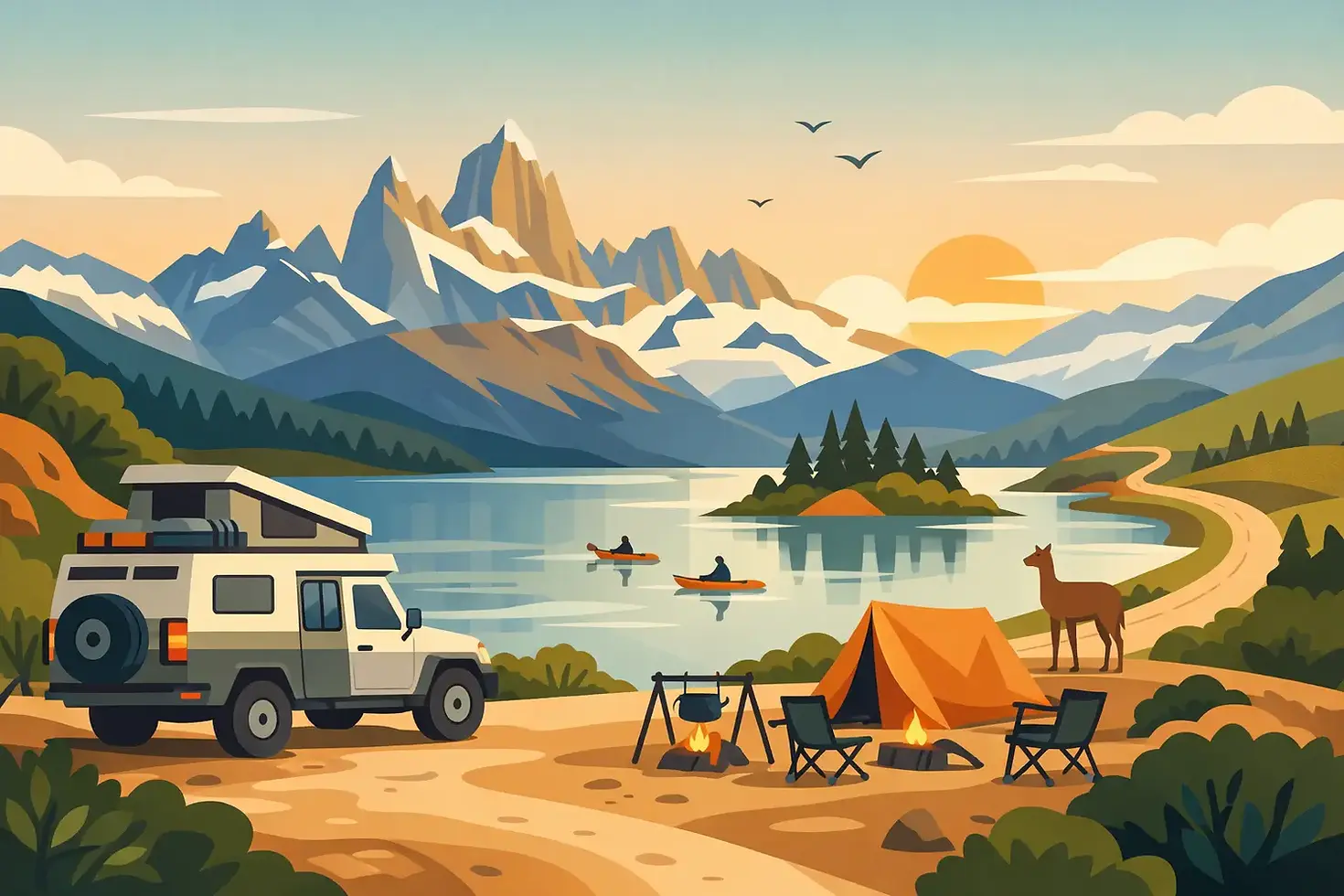
Patagonia Camper Rental Guide for Longer Trips
Patagonia rewards travelers who can change plans without losing momentum. A strong wind day may cancel a hike, a gravel road may take twice as long as expected, and a border crossing can reshape the next week of your route. This Patagonia camper rental guide is built around the decisions that protect your time: choosing the right vehicle, confirming cross-border permissions, and planning a route that works in real conditions rather than on a map.
For a trip of a few weeks, renting a camper is usually the most efficient way to get the freedom of overland travel without spending precious travel days on vehicle paperwork, registration, and resale. For a journey of three months or more, buying may become the better financial and logistical fit. The right answer depends on your route, group size, equipment, and how far north or east you intend to continue after Patagonia.
Choose a camper for the route, not the photo
Patagonia has excellent paved highways, but the places that make the region memorable often sit beyond them. You may drive long stretches of gravel, encounter strong crosswinds, use narrow access roads to trailheads, and cover hundreds of miles between major service towns. A camper should be selected for how you will actually travel.
A compact campervan works well for two people following the principal roads of Chile and Argentina, staying in campgrounds, and prioritizing lower fuel use and easier parking. It is generally the most comfortable option for travelers who want a proper interior sleeping setup without managing a large RV in wind or tight town centers.
A 4WD camper or 4WD vehicle with camping equipment is a better match if your plan includes remote tracks, fishing access, surf breaks, backcountry trailheads, or more flexibility in southern Chilean Carretera Austral territory. Four-wheel drive does not make every road safe, and it does not replace careful driving on loose gravel. It does, however, provide useful clearance and control where a standard van can be limiting.
Larger motorhomes provide more living space in poor weather, which matters in Patagonia. The trade-off is fuel consumption, maneuverability, and more exposure to wind. If your itinerary includes frequent city stops, ferry terminals, or short one-night stays, a smaller vehicle often makes the day-to-day experience easier.
Before confirming any rental, ask about sleeping configuration, heating, kitchen equipment, water capacity, tire condition, spare tires, and the included insurance excess. Do not assume a camper is equipped for winter simply because it has a bed and stove. Cold nights, rain, and wind can quickly expose gaps in the setup.
Patagonia camper rental guide: timing and seasons
The main Patagonia travel season runs from roughly November through March. Days are longer, many services operate at full capacity, and access is generally simpler. It is also the period when popular campgrounds, national park accommodations, vehicle rentals, and ferry spaces can sell out well ahead of time.
December through February offers the warmest conditions, but it is not reliably warm. Wind is a defining feature of the region, particularly around Torres del Paine, El Calafate, El Chaltén, and the open Argentine steppe. Build flexibility into your schedule for hiking days and driving days. A route that looks comfortable with perfect weather can become rushed when visibility drops or wind makes a long drive tiring.
Shoulder season can be excellent for travelers who prefer quieter roads and are prepared for colder, less predictable conditions. From April onward and through early spring, some seasonal services reduce availability, certain campgrounds close, and mountain weather becomes a larger operational factor. Confirm opening dates directly with your rental provider and avoid building a plan around assumptions.
A practical rule is to leave at least two unplanned days in a two-week itinerary, and more if you are traveling the Carretera Austral or combining Chilean and Argentine Patagonia. Those days are not wasted time. They are what allow you to wait out weather, take an unexpected detour, or stay another night somewhere worth staying.
Confirm border travel before you reserve
Chile and Argentina are natural partners in a Patagonia itinerary. The most efficient routes often cross between the two countries more than once, especially when connecting Torres del Paine, El Calafate, El Chaltén, Bariloche, and the Carretera Austral.
But you cannot treat a rental camper like a personal car at the border. Cross-border travel requires the rental company’s written authorization, and the documents must be prepared correctly before you reach immigration and customs. Requirements can change, border hours vary by crossing and season, and some rental agreements do not allow international travel at all.
Ask these questions before you pay a deposit: Is travel into Argentina permitted? Which border crossings are approved? Is the required authorization included in the rental process? How far in advance must you request it? Does the insurance apply in both countries? Are there restrictions on unpaved roads, ferry travel, or remote areas?
Keep original vehicle paperwork and your passport accessible, not buried under camping gear. At the border, patience is part of the plan. Food and agricultural rules are especially strict when entering Chile, so declare items honestly and do not carry fresh produce, meat, seeds, or other restricted goods across without checking the current rules.
Build a route with realistic driving days
Patagonia distances are deceptive. A line between two points may look short, but gravel, wind, construction, photo stops, fuel planning, and border processing can turn it into a full day. Driving after dark is not ideal, particularly on unfamiliar roads where wildlife, changing surfaces, and fatigue are real concerns.
For a first camper trip, a two-week loop focused on southern Patagonia is often more rewarding than attempting the entire region. You can fly into Punta Arenas or Puerto Natales, travel through Torres del Paine, cross to El Calafate and El Chaltén, then return through a logical border crossing. The exact direction depends on vehicle pickup, border authorization, and your hiking priorities.
A three- to four-week trip gives you room to include more of Chilean Patagonia, such as the Carretera Austral. This route is extraordinary but should not be rushed. Fuel stations can be far apart, road surfaces vary, and ferry schedules can affect your timing. Fill up when practical rather than waiting for the next town, especially when your fuel gauge reaches the halfway point.
Download offline maps before leaving major towns. Cell coverage can disappear for long periods, and a paper overview map is still useful when you need to understand alternative roads. Keep enough drinking water, food, warm layers, and a charged power bank for an unexpected delay.
Camp with flexibility and respect for local rules
A camper gives you options, not permission to sleep anywhere. Patagonia includes national parks, private land, protected areas, small communities, and roadside locations where overnight parking may be restricted or unsafe. Use established campgrounds when possible, particularly near national parks and major hiking hubs.
Campgrounds also solve practical problems: bathrooms, showers, water, trash disposal, and a sheltered place to reset after several days on the road. In peak season, reserve popular locations when your route has fixed dates. Elsewhere, keep your schedule open enough to choose a campsite based on weather and arrival time.
If you do stay outside a campground where it is permitted, leave no trace. Do not light fires in exposed or dry areas, do not block roads or gates, and do not dump gray water or toilet waste. Wind carries litter farther than you expect, and the landscapes you came to see are fragile.
Know when rental stops making sense
Renting is the clean solution for travelers who want to arrive, collect a prepared vehicle, and start moving. You know the cost upfront, you avoid ownership transfer procedures, and you return the camper at the end of the trip. This is especially valuable when your travel window is under three months or your flights have fixed dates.
For longer South America travel, ownership can create more freedom and may reduce your overall vehicle cost. It also brings administrative steps that international travelers cannot ignore. In Chile, non-residents need the correct tax identification and purchase documentation, and ownership transfer takes planning. Selling at the end also needs a strategy, not a last-week scramble.
Suzi Santiago helps travelers make that decision before it costs them time on the ground. If your route runs beyond Patagonia into central Chile, Argentina, Bolivia, Peru, or Brazil, discuss your intended timeline early. A rental is not automatically the cheaper choice, and buying is not automatically the freer one. The trip length and exit plan decide it.
Final checks before pickup
At pickup, take photos and video of the exterior, tires, windshield, interior equipment, and fuel level. Ask how to operate heating, the refrigerator, stove, water system, battery setup, and any roof tent or awning before you leave. Test the equipment while you are still near the rental location.
Confirm roadside assistance procedures, emergency contact numbers, permitted roads, fuel type, return time, cleaning expectations, and the location for waste disposal. These details are straightforward when handled at pickup and frustrating when discovered on a rainy evening hundreds of miles away.
The best Patagonia camper trip is not the one that covers the most distance. It is the one with enough vehicle capability, paperwork, and spare time to let the landscape set the pace.


Comments