


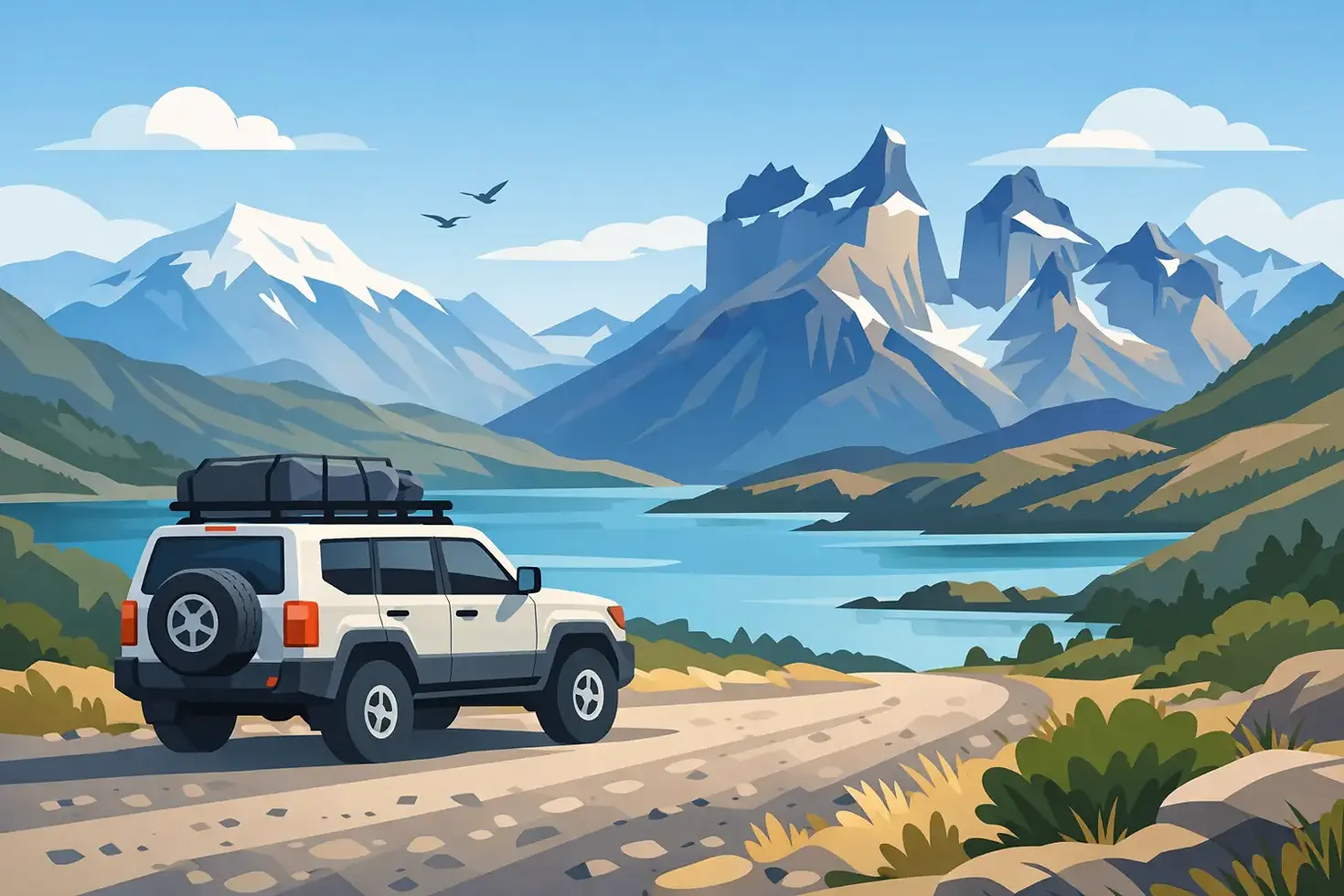
4WD Rental Chile Patagonia Route Guide
If you are planning a 4WD rental Chile Patagonia route, the first mistake to avoid is assuming Patagonia works like a normal road trip. Distances look manageable on the map, but wind, gravel, ferry schedules, border crossings, and fuel gaps can turn a short driving day into a full one. The right route is less about seeing everything and more about building a plan that fits your time, season, and tolerance for rough roads.
For most travelers, a 4WD makes sense in Patagonia for flexibility rather than speed. You are not renting it to drive fast. You are renting it to handle ripio with more confidence, reach trailheads and remote camps with less stress, and carry the gear that makes a long overland trip easier. That matters even more if you plan to combine Chile and Argentina, where road surfaces and service availability can change quickly.
When a 4WD rental Chile Patagonia route makes sense
A 4WD is not mandatory for every Patagonia itinerary. If your trip is short and you plan to stay on major paved corridors, a standard vehicle may be enough. But if you want to drive sections of the Carretera Austral, access more remote parts of Torres del Paine, camp regularly, or continue into Argentina on secondary roads, the extra clearance and traction are usually worth it.
The trade-off is cost. A 4WD rental is more expensive, and fuel consumption is usually higher. If your goal is simply to move between hotels in Puerto Natales, El Calafate, and Punta Arenas, paying for a full overland setup may not be the best use of your budget. If your goal is freedom, self-sufficiency, and route flexibility, it usually is.
Start with your trip length, not the map
The best Patagonia route depends first on how many days you actually have on the ground. Travelers often try to fit Santiago, the Lake District, the Carretera Austral, Torres del Paine, El Chalten, and Ushuaia into one trip. That is possible only if you have enough time and accept long driving days.
With 10 to 14 days, it is usually smarter to focus on one zone. That might mean southern Patagonia around Puerto Natales and Torres del Paine, or northern Patagonia around Puerto Varas and the start of the Carretera Austral. With three to six weeks, you can build a more complete one-way route. With several months, the conversation shifts from renting to whether buying a vehicle saves money and gives you more route freedom.
That is where working with an operator that understands both rentals and long-term overland planning matters. Suzi Santiago, for example, helps travelers decide when renting is the better move and when a multi-month trip justifies buying instead.
The three route styles most travelers choose
1. Southern Patagonia loop
This is the simplest option if you want big scenery without committing to a long expedition. A common version starts in Punta Arenas or Puerto Natales, includes Torres del Paine, crosses into Argentina for El Calafate or El Chalten, and loops back into Chile.
This route works well for travelers with two to three weeks. Roads are more developed than many expect, but weather is still the real variable. Strong winds can affect driving more than the road surface itself, especially with a camper setup or rooftop load. Border timing also matters. You do not want to plan a major hike on the same day as a long international crossing.
2. Carretera Austral north-south route
If your priority is remote driving, river valleys, mountain views, and frequent gravel, this is the classic 4WD rental Chile Patagonia route. Many travelers begin around Puerto Montt or Puerto Varas, take the ferry south, and drive through Puyuhuapi, Coyhaique, Cerro Castillo, Puerto Rio Tranquilo, Cochrane, and Villa O'Higgins.
This route rewards patience. Distances are not huge, but driving times can be slow. Ferry planning is part of the route, and weather can change your pace. A 4WD is useful here because conditions are inconsistent, shoulders can be rough, and side trips often involve less maintained roads.
3. Cross-border overland route
This is the best fit for travelers who want both Chile and Argentina in one trip. A strong version starts in Chilean Patagonia, crosses into Argentina for Ruta 40 and key trekking areas, then returns to Chile or continues north or south depending on time.
The advantage is variety. Chile gives you fjords, forests, ferries, and the Carretera Austral. Argentina gives you long open drives, easier road continuity in some areas, and access to major highlights like El Chalten. The trade-off is paperwork. Not every vehicle can cross borders automatically, and this is where rental planning needs to be exact before the trip starts.
What road conditions are really like
Patagonia road conditions are rarely difficult in a technical off-road sense, but they are often tiring. Gravel washboards, potholes, roadworks, narrow shoulders, and crosswinds add up over a week or two. You can drive all day and still cover fewer miles than expected.
In Chile, sections of the Carretera Austral can be beautifully maintained one day and rough the next after weather or grading. In southern Patagonia, paved roads are common near major gateways, but side roads to campsites, trailheads, and viewpoints may be loose gravel or deeply corrugated. In Argentina, long gravel sections are still part of many classic routes, even when the main highways are more straightforward.
That is why realistic daily planning matters more than optimistic mileage targets. On a Patagonia trip, 150 miles may feel easy one day and ambitious the next.
Season changes the route more than people expect
The main season runs roughly from November through March, with January and February as the busiest months. That is when services, ferries, and park access are most reliable, but it is also when demand and pricing are highest.
Shoulder season can be excellent if you want fewer people and do not mind colder nights. The downside is that some services reduce hours, weather windows tighten, and road delays become more consequential. In early spring and late fall, a 4WD gives you a larger margin for changing conditions, but it does not remove the need for caution.
Winter is a different planning category. Some routes remain possible, but it becomes a specialist trip rather than a general self-drive vacation. If that is your plan, vehicle setup and daily route decisions need to be much more conservative.
Fuel, supplies, and pacing
One of the biggest planning errors on a 4WD rental Chile Patagonia route is treating fuel as an afterthought. In the south, stations can be far apart, hours may be limited, and occasional shortages do happen. The practical rule is simple: refill early, not later.
The same goes for food, water, and data coverage. You do not need to overpack for every possibility, but you do need enough reserve to handle a delayed ferry, a weather hold, or a long stretch without services. This matters even more if you are carrying camping gear or traveling with surf, hiking, climbing, or kitesurfing equipment that adds weight and space pressure.
Pacing is where good itineraries stand out. Build in buffer days. If you plan every night in a different place, Patagonia will eventually force a change. If you leave room for weather, mechanical delays, and a day you simply want to stay longer, the trip becomes much easier to enjoy.
Border crossings and paperwork are not a small detail
For foreign travelers, cross-border vehicle use in Patagonia needs to be arranged correctly from the start. That includes authorization, timing, and understanding where the vehicle is legally allowed to go. This is not something to sort out at the border window.
The same principle applies if your trip is long enough that buying starts to make more sense than renting. In Chile, legal ownership and foreigner documentation involve timing, and those timelines should shape your route. If you are looking at a three-month-plus trip, it is worth comparing the total cost of renting against buying and reselling with proper support.
How to choose the right route for your trip
If you want the least complicated trip, keep your route regional and avoid unnecessary border hops. If you want the classic overland experience, choose a route that combines the Carretera Austral with at least one Argentina crossing. If you want maximum efficiency on a multi-month trip, start by comparing rental cost against the buying process before you lock your itinerary.
The best route is the one that protects your travel time. That usually means fewer driving marathons, fewer assumptions about border speed, and more respect for Patagonia's pace. Get the vehicle choice right, get the paperwork handled before departure, and leave enough margin in the route for the things Patagonia always changes. That is how you end up with the trip you planned, not the one you spend half your time trying to fix.


Comments